BONAR LAW HOUSE
When the former Clyde Street School was converted and extended to become the Helensburgh and Lomond Civic Centre in 2015, the former janitor's house became Bonar Law House. It is now used by the social work department of Argyll and Bute Council as temporary accommodation for people in urgent need of re-housing.
This brief article was written to explain to anyone living there how Bonar Law House got its name, and it is on display in the building.
*******************************************************************************************************
BONAR LAW HOUSE
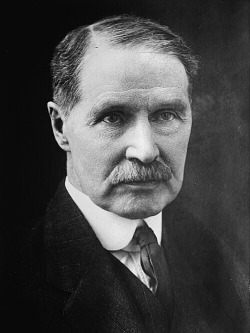
How did this building get its name? Andrew Bonar Law was a Helensburgh resident who became British Prime Minister.
Bonar Law by Walter Stoneman 1923
Did Bonar Law live in this building? No. This used to be the janitor's house for Clyde Street School. However for a while Bonar Law lived in a house called Seabank which until the 1950s stood where the main car park for the Civic Centre now is.
Where was he born? He was born on 16 September 1858 in New Brunswick in Canada. He was the first British Prime Minister to be born overseas.
How did he come to live in Helensburgh? His mother, who was a member of the Kidston family from Helensburgh, died when Bonar was only 2 years old. Ten years later his father remarried and it was decided at that time that he should come and live with his Kidston relatives in Helensburgh.
When he came here he at first lived with his aunt Janet Kidston in the house called Seabank. Later the house became his, and later he had another home in Helensburgh.
How did he get into politics? His Kidston relatives helped to set him up in the iron trade in Glasgow, and he was very successful. He later became interested in debating and politics, and was elected an MP for the first time in 1900, representing the Conservative party.
How did he become Prime Minister? During the First World War King George V asked Bonar Law to become Prime Minister, but he declined, believing that Lloyd George would be a better wartime leader. He subsequently served in Lloyd George's Wartime Coalition Cabinet. He finally became Prime Minister in October 1922.
For how long was he Prime Minister? Only for 209 days. He had to resign in May 1923 because he had been diagnosed with incurable throat cancer. He died roughly 6 months later on 30 October 1923.
He had the shortest spell as Prime Minister of any politician in the 20th century. Other Prime Ministers both in the 19th and 21st centuries have spent less time in office.
What did he do in Helensburgh? He worshipped in what is now Helensburgh Parish Church, where he and other family members are commemorated in a stained-glass window. He was also a prominent member of the local golf and tennis clubs. There is a family grave in Helensburgh Cemetery. Although he is commemorated on the gravestone, his ashes were buried in Westminster Abbey in London.
Sidebar
Magazine menu

12
Thu, Nov